


TL;DR
The Q1 2026 OpenVault Broadband Insights (OVBI) Report: Upstream Unleashed confirms what the data has been pointing to for four years: upstream is no longer the afterthought of broadband planning. DOCSIS upstream usage grew 19.9% year-over-year, outpacing downstream for the fourth straight year. On fiber, average upstream hit 106.7 GB—87.4% higher than DOCSIS—and the first time it has ever crossed 100 GB.
OpenVault partnered with Aispire to dig deeper into what’s driving these numbers. Aispire’s application-layer classification shows what’s driving the growth: cloud sync is the #1 upstream category across every speed tier, AI tools are compounding it, and residential and non-residential subscribers behave like two entirely different networks. Operators still planning against a download-first model, without visibility into application behavior and subscriber segmentation, are working with an incomplete picture.
A Complementary Partnership
For most of broadband’s history, operators planned around one foundational assumption: subscribers download far more than they upload. That assumption shaped network architecture, capacity investment, and the metrics operators use to measure performance. It was largely correct, and for a long time, it held.
It’s still mostly true. But the first quarter 2026 edition of the OpenVault Broadband Insights (OVBI) Report: Upstream Unleashed (linked below) clearly shows that the gap between upstream and downstream is narrowing, and the reasons go well beyond faster speeds and more devices.
For this edition, OpenVault combined its subscriber-and-tier data with Aispire’s application-and-host intelligence. OpenVault tells an operator that a subscriber used 1.2 TB last month. Aispire breaks down that 1.2 TB—showing that 38% was video streaming, which CDNs delivered it, how those paths performed, and how the rest split across gaming, cloud sync, and software updates. Together, we reveal that upstream is growing, what’s driving it, and where it’s headed.
An OpenVault and Aispire collaboration might not be obvious from the outside. The network analytics space can be confusing—a lot of vendors claiming to do similar things. What our partnership demonstrates is that the most insightful tools in this space aren’t always competing; sometimes they’re complementary. OpenVault measures the volume and signal quality of what’s happening across millions of subscribers. Aispire explains the composition—what applications are driving it, how behavior differs by subscriber segment, and where operators should focus. That combination, which we also explored together on the “Analytics at Work: Delivering a Best-in-Class Network Experience” panel at the NCTC WEC Conference this year, is what makes this edition of the OVBI Report even more compelling and we are thrilled to be a part of it.
Four Years of Upstream Acceleration
The average U.S. broadband household still downloads far more than it uploads—663.6 GB downstream versus 56.9 GB upstream in Q1 2026. The asymmetry hasn’t reversed. But it is shrinking, faster than many operators’ planning models currently account for. Upstream has outpaced downstream growth for four consecutive years running.
The 1Q26 OVBI Report puts that shift in sharp relief. DOCSIS upstream usage grew 19.9% year-over-year, outpacing downstream for the fourth straight year. Fiber upstream hit 106.7 GB—the first time exceeding 100 GB and 87.4% higher than DOCSIS. That’s not a behavior driven by one or two use cases. It’s structural. And understanding what’s driving it requires looking beyond the traffic volume to the applications underneath.

AI, Cloud, and a New Generation of Upload Behavior
This is where Aispire’s intelligence adds something the volume numbers alone can’t show.
Using Aispire’s application-layer classification across a selected broadband service provider—spanning March 2025 through March 2026—Aispire identified aggregate upstream growth of 17.6% year-over-year, consistent with OpenVault’s 19.9% per-subscriber measurement on its broader DOCSIS panel.
What Aispire’s data reveals is what’s driving that growth. Cloud sync is the dominant upstream category, accounting for 15–16% of classified upload volume across every speed tier. Not just at gigabit. Not just among power users. Across the entire subscriber base, from sub-50 Mbps plans to 1 Gbps+, cloud sync sits at the top of the upload stack. And it’s growing organically: cloud upload traffic rose 19% between September 2025 and March 2026, measured to capture genuine behavioral growth.
The largest contributor to this is AI—and the timeline explains everything. OpenAI launched o1 in September 2024 and o3 in December 2024, but enterprise and consumer adoption of reasoning models hit its stride in mid-to-late 2025. By fall 2025, reasoning models were the default in ChatGPT Plus, Microsoft Copilot, and Google Gemini Advanced—meaning tens of millions of users routinely uploading large context windows (how much data an AI model can process at once—your prompt, the conversation history, any documents you upload, etc.; with reasoning models, users started routinely sending much larger amounts of data: entire documents to summarize, long chat histories, multiple files to analyze) as part of normal daily use, not just early adopters. Microsoft began broad commercial rollout of Copilot across Microsoft 365 in late 2024, with enterprise deployments completing through 2025. By fall 2025, the majority of large enterprise Microsoft customers had Copilot active—every Word document, Excel file, and Teams meeting generating background AI processing traffic. Apple’s on-device and cloud AI features shipped with iOS 18 and macOS Sequoia in fall 2024 and expanded through 2025. By fall 2025, hundreds of millions of Apple devices were running AI features syncing to iCloud.
This goes beyond adoption and moves into infrastructure. Subscribers didn’t opt into AI; it embedded itself in the tools they were already using. Fall 2025 also saw the emergence of agentic AI—tools that autonomously complete tasks, browse the web, write code, and manage files. Agentic workflows upload and download files continuously. This is qualitatively different from a chat query—it’s a sustained, multi-step cycle that looks more like a cloud backup job than search traffic. None of this is occasional. It’s persistent background activity that subscribers don’t initiate and often don’t notice—and as AI embeds further, this baseline will only compound.
Beyond cloud sync, several application categories are structurally upload-dominant in ways that may surprise operators whose planning models were built around a download-centric internet:
| Category | D:U Ratio | What’s Driving It |
| IoT | 1:7 upload-dominant | Smart home devices—cameras, sensors, doorbells—uploading continuous telemetry |
| Automotive | 1:3 upload-dominant | Connected vehicles uploading diagnostics and GPS data |
| Web Search | 1:2 upload-dominant | Voice search and multimodal AI query payloads |
These categories don’t behave like streaming video or file downloads. They’re persistent, background, and invisible to monitoring tools that only track aggregate throughput. Upstream share of total traffic has been shifting steadily, from 7.3% to 7.9% over the measurement period, a move that looks small in percentage terms but represents significant absolute volume at the scale of millions of subscribers.
Two Networks Inside Your Network
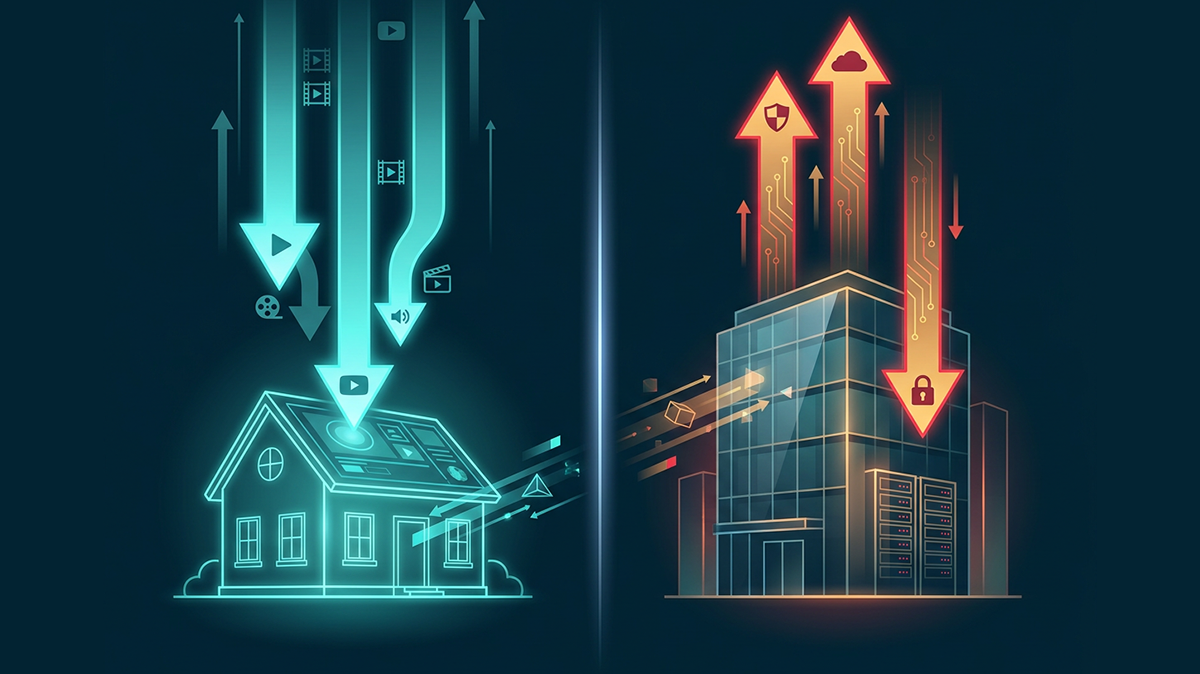
The 1Q26 OVBI Report introduces something new: the first-ever residential versus non-residential behavioral breakout in the report’s history. The difference is stark, and it has direct implications for capacity planning.
Residential subscribers run at a 28:1 download-to-upload ratio. Video accounts for 48% of all downloads; gaming adds another 6.8%. This is a classic consumption profile—subscribers primarily receiving content, rarely sending it in volume.
Non-residential subscribers run at a 12:1 ratio, nearly 2.3x more symmetric. Cloud accounts for 20% of their uploads, with a near-symmetric 1.6x D:U ratio. At 1 Gbps+ speed tiers, that picture sharpens further: cloud comprises 25.5% of non-residential upload traffic.
Cybersecurity applications, like SIEM platforms, endpoint detection, and threat feeds, approach 1:1 symmetry. So do internet technology categories like DNS, infrastructure, and API traffic.
These aren’t power users consuming more of the same thing. They’re businesses running servers, cloud infrastructure, and security operations over their broadband connections. Their upstream demand looks more like a data center than a household, and it needs to be modeled that way.
Operators who treat residential and non-residential traffic as one planning segment are systematically misreading their own network. The capacity needs, the failure modes, and the subscriber experience expectations are fundamentally different. The OVBI Report’s operator takeaway is direct: these two segments should be modeled separately.

The Visibility Gap and Why It Matters Now
Traditional network monitoring was built for a downstream-first world. Traffic counters, SNMP polling, and aggregate utilization metrics answer one question: Is the network full? They weren’t designed to answer: What is filling it, and what does that mean for next quarter, let alone next year?
That distinction matters more now than it ever has, for three reasons.
That distinction matters more now than it ever has. A network carrying cloud sync and AI-driven upload traffic behaves differently—and fails differently—than one carrying streaming video. AI-driven upload activity is largely invisible to traditional monitoring. Background sync, agentic workflows, and ambient device traffic don’t generate the same signatures as large file transfers. They look like low-grade noise until they accumulate into a capacity constraint, at which point the problem is already downstream of where it could have been addressed.
This is precisely where application-layer classification becomes essential. Aispire’s platform identifies and tracks these background AI workflows, cloud sync patterns, and IoT telemetry streams at the subscriber and application level—making the invisible visible before it becomes a capacity problem. It’s the difference between reacting to what happened and understanding what’s coming.
What This Means for Operators
The 1Q26 OVBI Report’s title says it plainly: Upstream Unleashed. The data backs it up. Broadband was designed for a downstream-first world. The infrastructure, the planning models, and the monitoring tools were all built on that premise. The premise is eroding—not dramatically from one quarter to the next, but structurally, and with acceleration each year.
An operator seeing 19.9% upstream growth knows the traffic is increasing. An operator seeing that cloud sync comprises 15–16% of uploads across all tiers, that non-residential subscribers run at a 12:1 D:U ratio instead of 28:1, and that AI-driven workflows are compounding in the background—that operator understands what’s driving the growth and why it matters.
For cable operators, this is about more than capacity. It’s about latency, lag, and application performance. The industry learned from gaming that applications requiring upstream bandwidth emerge faster than network planning cycles can anticipate—which is why visibility into what’s driving upstream growth matters now. And it’s about staying competitive with fiber providers who already deliver more symmetric bandwidth. Cable operators need to understand these traffic patterns to make informed decisions about where upstream constraints will impact subscriber experience.
For fiber operators, understanding application composition matters just as much. Fiber upstream averaged 106.7 GB in Q1 2026 — 87.4% higher than DOCSIS — but knowing what’s filling that pipe is essential for capacity planning as AI-driven workflows and cloud sync continue to grow. Even with symmetric or near-symmetric bandwidth, operators need visibility into whether that growth is residential cloud backup, non-residential infrastructure traffic, or ambient AI processing—because each has different implications for how and where to expand.
While OpenVault’s subscriber usage data reveals the trends, Aispire’s application intelligence explains them. For operators trying to stay ahead of upstream demand, that combination—understanding both the scale and the composition of the shift—is what turns reactive capacity planning into proactive strategy.
Read the full 1Q26 OVBI Report, Upstream Unleashed, on OpenVault’s website: https://na2.hubs.ly/H05zK_V0
Want to see what’s driving upstream growth on your network? Aispire gives operators the application-level visibility to understand what’s happening—and plan for what’s coming. This is just one of the features we offer – we’d love to show you our new Conversational AI and Service Degradation tools. Book some time with us here: https://na2.hubs.ly/H05B0GW0